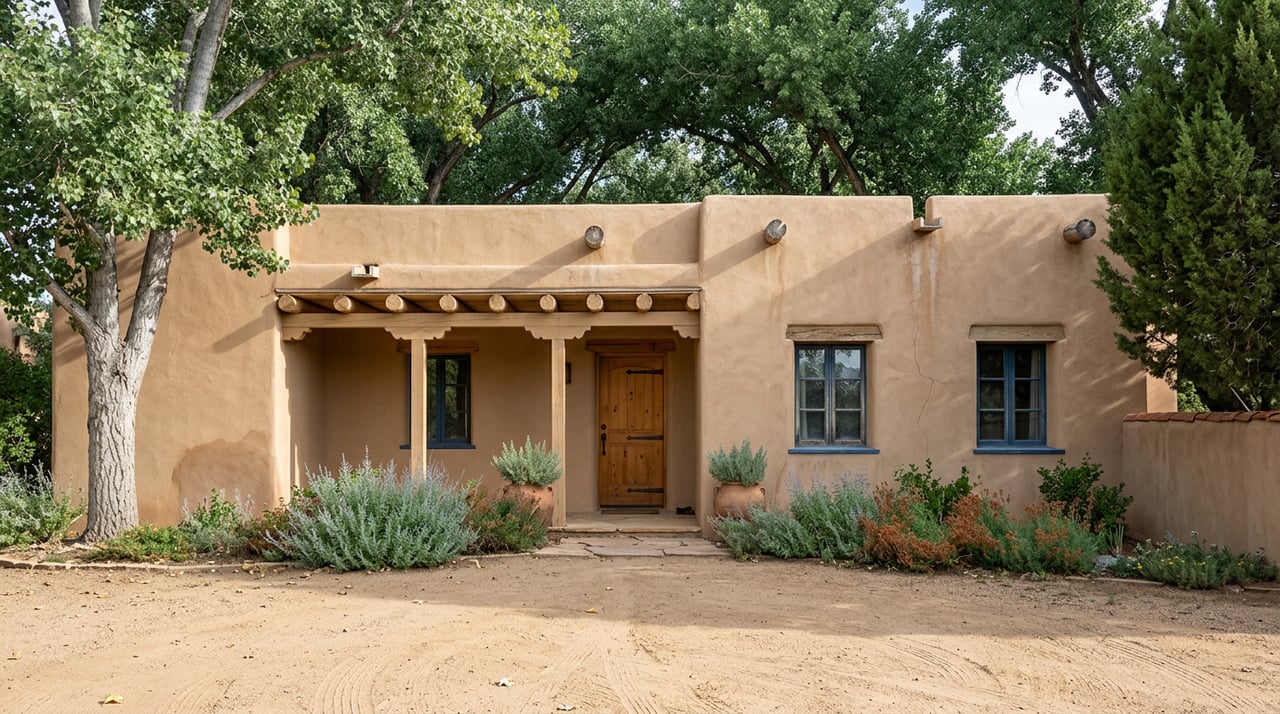
Two Tesuque offers come in a week apart on similar adobes. The first goes under contract at ask. By day fourteen it is being rewritten, twice, around a missing pump test and an unrecorded shared-well agreement. The second is priced identically, but the seller hands the buyer's attorney a labeled binder on the first showing. It closes on the original terms.
The property that sold on the original terms was not better built. It was better documented. In this valley, that gap is the price.
The file, not the finish, sets the ceiling
Most sellers prepare a Tesuque home the way they would prepare any Santa Fe listing: plaster touch-ups, a photographer with a drone, a stager who understands vigas. That work matters. It is not what a Tesuque buyer's attorney is looking at.
Tesuque is an unincorporated community in Santa Fe County where properties fall under county zoning and permitting and most homes rely on well water and septic systems rather than municipal utilities. That single fact reorganizes an entire transaction. The buyer is not underwriting the kitchen. They are underwriting a private utility system, a set of state-administered water rights, and, on many valley parcels, a share in a centuries-old irrigation cooperative. The seller who can produce clean records for each of those things holds the ceiling. The seller who cannot watches it fall in inspection response.
What county jurisdiction actually changes
City buyers are used to a utility company handling water quality and a public sewer handling waste. Neither exists here. The New Mexico Environment Department's Drinking Water Bureau oversees public systems serving at least 15 connections or 25 people; private wells fall outside that regulatory authority, and it is up to the owner to test, maintain, and ensure the quality of the water. Translation for a seller: no one has been watching the well on your behalf, and no one has been watching it on the buyer's behalf either. Whatever record exists is the record you built.
Septic is the same story in reverse. The system is yours until closing, and a buyer's inspector is going to ask when it was last pumped, whether the drain field has been located and mapped, and whether any additions to the house ever expanded the fixture count beyond what the original permit contemplated. Answers that live only in the seller's memory are answers that become price adjustments.
The five documents a Tesuque buyer's attorney will ask for
Every experienced buyer's counsel in this market runs the same checklist. The specifics vary, but the shape does not.
| Document | Where it lives | What an absence signals to the buyer |
|---|---|---|
| Well log and OSE permit | New Mexico Office of the State Engineer records; original driller's report | Undocumented well; potential permit or basin issue |
| Recent water-quality panel | Certified NM laboratory report | Unknown arsenic, uranium, nitrate, or coliform exposure |
| Pump service and yield test | Well contractor invoices | Unknown capacity; risk of failure inside first year |
| Septic permit, as-built, and pump record | Santa Fe County Planning and Environmental Health | Unpermitted work; unknown tank location |
| Acequia membership and assessment history | Local ditch association; commissioners' records | Uncertain irrigation rights, unpaid dues, or maintenance obligations |
The Environment Department recommends testing private wells for bacteria such as coliform, nitrate, arsenic, and uranium, all of which occur naturally in parts of northern New Mexico. A lab report older than a year invites the buyer to order their own on your dime and delay the schedule. A lab report from the last ninety days closes the question.
The 87506 aquifer problem your neighbor's yield doesn't solve
There is a specific reason yield reports matter more here than in most of the country. Santa Fe County geology is not a broad alluvial basin that produces consistent well performance across a subdivision. Much of the area around Tesuque draws from fractured-rock aquifers, where two wells drilled the same week on adjoining parcels can produce very different flow rates. A buyer who has read even one article about 87506 wells knows this and will not accept "the neighbor gets plenty" as evidence.
The seller's response is a documented flow test performed by a licensed well contractor, ideally within the last twelve months, showing gallons per minute over a sustained draw. If the number is modest, the fix is not silence. The fix is a cistern quote, a treatment quote, or a plumbing configuration note in the disclosure so the buyer prices the solution instead of imagining the worst version of it.
Acequia shares are a governance question, not a plumbing question
Buyers relocating from Texas or California often assume acequia water is a utility. It is not. It is a share in a community irrigation system with its own commissioners, its own annual assessments, and its own maintenance labor expectations. For a seller, the disclosure is not "the ditch runs behind the house." The disclosure is the parcel's specific right, the annual dues, any outstanding obligations, and any peaceful history or dispute with neighboring parciantes. The New Mexico Acequia Association is the practical starting point for a buyer who wants to understand what they are inheriting, and pointing them there before they ask puts the seller in the position of educator rather than defendant.
Tesuque's landscape is what it is because these systems still function. The buyer who came here for the cottonwoods should be told, in writing, how the cottonwoods get watered.
What New Mexico's disclosure act actually requires, and what it doesn't
This is the part where out-of-state sellers get caught. The disclosure requirements for New Mexico home sellers are laid out in the Real Estate Disclosure Act at §47-13, which is unusual in that its statutory focus is almost exclusively on tax issues. The physical condition of the property is addressed through the Seller's Property Disclosure form, industry practice, and the common-law duty not to conceal known material defects. A seller who is genuinely not aware of an issue can answer "no," and the broker holding a professional license is separately expected to disclose adverse material facts the broker actually knows about the property or the transaction.
Two implications for a Tesuque sale. First, "I didn't know" is a defensible answer only if it is true, and once a lab test or an inspection puts something in front of you, the answer changes. New Mexico requires sellers to amend the disclosure form if they learn something new between the initial signing and the close of the sale. Second, the disclosure form's questions about well production, water quality, ditch or irrigation rights, and drought or legal restrictions are exactly the questions the file above answers. Filling them in with document references rather than shrugs is the difference between a clean escrow and a renegotiated one.
Assembling the file before you list
The work is finite. In roughly the order a seller should tackle it:
- Pull the well log and any permit history from the Office of the State Engineer's records and confirm the parcel's basin status.
- Order a current water-quality panel from a New Mexico certified laboratory covering, at minimum, total coliform, E. coli, nitrate, arsenic, and uranium.
- Book a pump service and yield test with a licensed well contractor, and keep the written result.
- Retrieve the septic permit and as-built from Santa Fe County Planning and Environmental Health, pump the tank if it has been more than a couple of years, and get an inspection report.
- Contact your acequia mayordomo or commissioner for a membership and assessment letter, and locate the deed language that describes the water right.
- If the well is shared, produce the written agreement. If there is no written agreement, get one signed now, while the neighbors have no reason to negotiate against you.
- Update the Seller's Property Disclosure with the results and attach the documents as exhibits.
None of this is glamorous. All of it is priced.
When the file becomes the price
Tesuque's 2026 market rewards preparation more than it rewards timing. Balanced conditions across Santa Fe mean well-priced homes still move, but the first two weeks are decisive and overpricing without a story to support it gets punished. On a valley parcel with a private well, an acequia share, and county jurisdiction, the story that supports the price is the file. Buyers pay a premium for certainty, and every document in the binder is one less contingency in the offer.
The seller who treats the water file as an afterthought is asking the buyer to price the unknown. The seller who treats it as part of the listing package is asking the buyer to price the house. Those are different numbers.
If you are considering a Tesuque sale this year and want a candid read on what your specific parcel's file looks like, and what it is likely to be worth once it is complete, Go West Real Estate Partners is glad to walk the property with you and start the list. Contact Us.