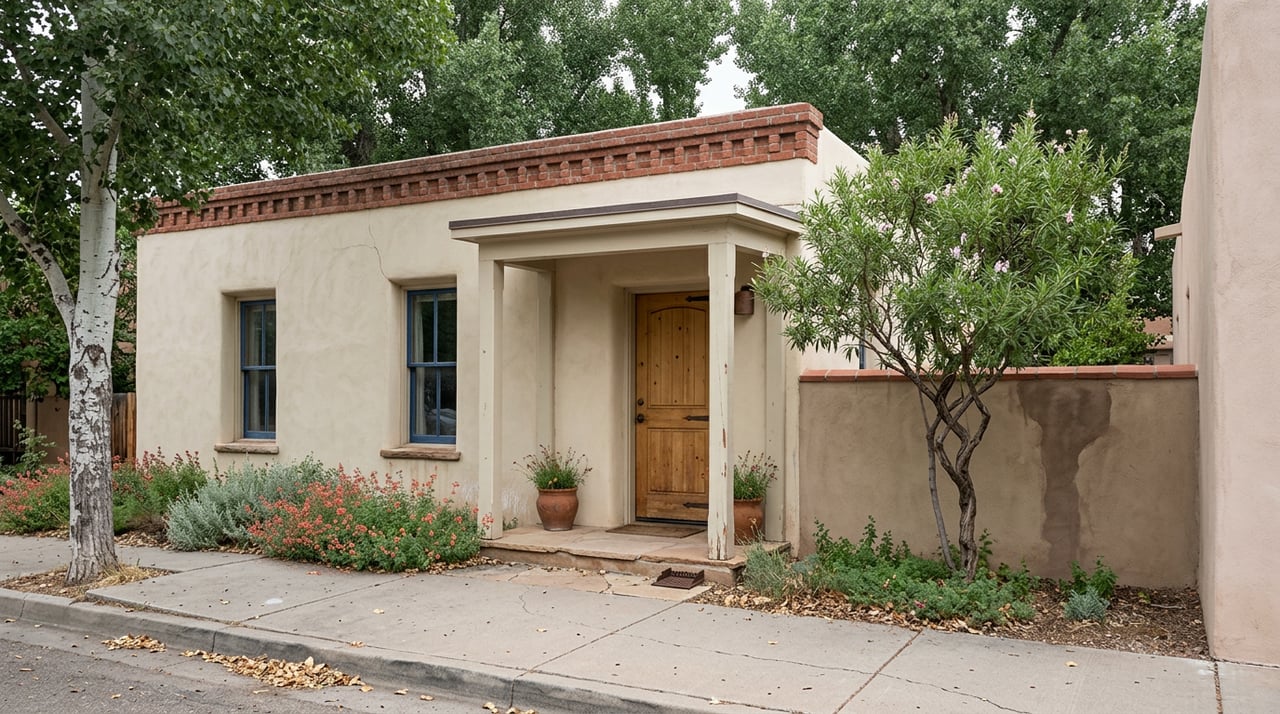
The citywide headline for Santa Fe in 2026 reads balanced, softer, more buyer-friendly. That is true, and it is also not quite the story on the blocks between the Roundhouse and the Railyard. South Capitol is one neighborhood on a map and two markets on a spreadsheet, and the line between them sits somewhere around $800,000.
Anyone comparing neighborhoods from out of state has already seen a median, probably a different one on every site they opened. What that median does not tell you is which South Capitol you are actually shopping in, and how differently a well-written offer needs to read on each side of that line.
Two submarkets, one zip code
South Capitol's inventory runs roughly $400,000 to $1.5 million and occasionally higher, spanning small Craftsman bungalows near Wood Gormley Elementary, mid-century remodels off Don Gaspar, and larger Territorial and Pueblo Revival homes closer to Canyon Road. That spread is unusually wide for a walkable in-town neighborhood, and the 2026 market is treating the two ends of it as separate transactions.
| Segment | 2026 market posture | What the buyer actually feels |
|---|---|---|
| Under ~$600K | Still competitive; correctly priced homes move | Little room to negotiate on price, more room on terms |
| ~$600K–$800K | Balanced; mechanics track the citywide averages | Real negotiation, but only on the right house |
| Above ~$800K | Softer; more inventory, longer days on market | Meaningful leverage, especially past 60 days on market |
The reason this matters: the same neighborhood, the same school, the same walk to Modern General, and the mechanics of the offer flip depending on where the list price falls.
What the citywide numbers actually describe
Santa Fe's Q1 2026 report told a clean story. Single-family sales were down 11.4% year over year, days on market stretched from 56 to 87, the median sale-to-list ratio settled at 0.976, and nearly 73% of homes closed under list. Active inventory was around 663 properties across the city. Redfin's read on the three months ending May 2026 put the median a bit lower and days on market a bit tighter, closer to 58, which is the same market seen through a different slice of the data.
Both of those readings average across everything from a manufactured home on the south side to a compound off Old Santa Fe Trail. Neither one is describing South Capitol. What they are describing is the direction of pressure, and that direction is not uniform.
The under-$600,000 tier across the city is still absorbing buyers faster than sellers can price them out. The $800,000-and-up tier is where the softness lives, and it softens further as list prices climb. South Capitol has homes on both sides of that fault line, sometimes on the same block.
Where the line sits on the map
There is no clean street that separates the two markets, but a few patterns hold. Smaller lots north of Cordova and east of Galisteo, particularly the pre-war bungalows and Territorial cottages that trade on charm and walkability rather than square footage, tend to price under $800K and behave like the competitive tier. Larger renovated adobes closer to the Historic East Side border, or homes with guest houses and off-street parking for more than one vehicle, cross into the softer tier and stay there longer.
Two features flip a home from one market into the other faster than square footage does: a second dwelling with a certificate of occupancy, and a garage. Both are scarce in a neighborhood platted before either was standard, and both pull a listing into the $800K-plus band where the buyer, not the seller, is currently setting the pace.
Reading the offer mechanics
A 0.976 sale-to-list ratio is the citywide average. In South Capitol it splits.
Under $600,000, expect that ratio to run tighter to list, sometimes at list, occasionally above when a well-prepared home hits the market in April or May. The leverage the citywide report describes is not really available at this price point in this neighborhood. What is available is negotiation on repairs, on closing timing, on the seller carrying a credit for a specific inspection item. Sellers at this tier are usually motivated by their next purchase, not by price sensitivity, so the concession that costs them least is time.
Above $800,000, the same 0.976 becomes a floor rather than a ceiling. Homes listed in this band in the first half of 2026 are frequently closing 3 to 7% below list, and the ones that cross 60 days on market are closing further down than that. The 73% under-list figure is a citywide average; in the South Capitol upper tier it runs higher, and the discount is larger.
Between $600K and $800K, the market behaves closest to the reported averages, and the offer needs to reflect that: strong but not aggressive, clean contingencies, an inspection period that respects the age of the housing stock.
The friction most out-of-state buyers miss
South Capitol homes are old. Not old by Santa Fe standards, where old means three centuries, but old enough that the inspection is the negotiation. Knob-and-tube wiring in the attic, galvanized supply lines, original clay drain lines under mature cottonwood roots, chimneys that predate any liner code, additions built during periods when permit records at the city are incomplete or missing.
A buyer coming from a newer market often reads the inspection report as a list of failures. In South Capitol it is a list of expected findings, and the offer that succeeds treats it that way. Sellers here are used to seeing repair addenda that ask for a credit rather than the work itself, because the tradespeople capable of doing the work correctly on a hundred-year-old adobe are booked out and the credit lets both parties close on schedule.
The permit history is the item that quietly kills more South Capitol transactions than any other. If a prior owner enclosed a portal, added a bathroom, or converted a garage without pulling the permit, the record shows up during title review and the lender may condition funding on resolution. Building that lag into the timeline, and asking for the seller's disclosure of any unpermitted work up front, is not a hostile move. It is the standard courtesy at this price point in this neighborhood.
Writing the offer
For a serious buyer working South Capitol in mid-2026, the sequence that consistently produces a clean close looks like this:
- Identify which of the three tiers the home sits in before writing the number, not after.
- Price the offer to the tier, not to the average. An under-$600K offer written like an $800K offer leaves money on the table; an $800K offer written like a $500K offer signals a buyer who has not done the work.
- Ask for the permit history and any prior inspection reports in the same message as the offer.
- Set the inspection period to 10 to 12 days, long enough to get a specialist on the roof and a plumber on a camera scope.
- Frame repair requests as credits, not scopes of work, and expect the seller to prefer it that way.
- Build a two-week window between inspection resolution and closing for title and any permit clean-up.
None of that is aggressive. All of it treats South Capitol as the older, more specific market that it is, rather than as a line on a citywide report.
A short FAQ
Is South Capitol a buyer's market in 2026? Above roughly $800,000, yes. Below $600,000, not really. The citywide balanced-market description is accurate on average and misleading on any particular block.
Does the softer luxury tier extend below $1.5 million? It does in South Capitol. The lower ceiling here reflects lot sizes and the age of the housing stock, not a different kind of buyer. A $900,000 renovated adobe in South Capitol is behaving more like a $1.6 million property in a newer subdivision than the price tag suggests.
How long should a buyer expect a South Capitol transaction to take? From accepted offer to closing, 40 to 55 days is realistic once permit review and inspection scheduling are built in. Anything faster is either a cash deal or a house that has been renovated recently enough for the file to be clean.
Working the neighborhood
South Capitol rewards the buyer who reads the market at the block level rather than the city level, and it rewards the seller who prices to the tier the house actually belongs to rather than the tier the owner wishes it did. Both moves require someone who has been in these houses, read these inspection reports, and watched offers succeed and fail across the price spread.
If you are weighing a purchase or a sale in South Capitol this year and want a candid read on where a specific address falls in the 2026 market, Go West Real Estate Partners is happy to walk through it with you.